The (Finite) Product Topology
\[\newcommand{\ds}{\displaystyle} \newcommand{\curlies}[1]{\left\lbrace #1 \right\rbrace} \newcommand{\T}{\mathcal T} \newcommand{\Ext}{\text{Ext}} \newcommand{\B}{\mathcal B} \newcommand{\Sp}{\mathbb S}\]The (Finite) Product Topology
Let $X_1, …, X_n$ be topological spaces.
Let $\B_{X_1 \times … \times X_n}$ be the collection of subsets of $X_1 \times … \times X_n$ given by:
\[\B_{X_1 \times ... \times X_n} = \curlies{ U_1 \times ... \times U_n : U_i \subseteq X_i \text{ is open} }\]Then $\B_{X_1 \times … \times X_n}$ is a basis for $X_1 \times … \times X_n$, and we call the topology it generates the Product Topology.
Proof.
-
Basis covers the space
$X_1 \times … \times X_n \in \B_{X_1 \times … \times X_n}$, so $\ds \bigcup \B_{X_1 \times … \times X_n} = X_1 \times … \times X_n$
-
Points in intersections have basis elements surrounding them
Let $U = U_1 \times … \times U_n$ and $V = V_1 \times … \times V_n$ be elements of $\B_{X_1 \times … \times X_n}$, then \(\begin{align} U \cap V &= (U_1 \times ... \times U_n) \cap (V_1 \times ... \times V_n) \\ &= (U_1 \cap V_1) \times ... \times (U_n \cap V_n) \end{align}\)
Intersections of open sets are open, so $U \cap V$ is the product of open sets, so $U \cap V \in \B_{X_1 \times … \cap X_n}$. Thus, every element in $U \cap V$ has an open ball around it contained in this intersection, $U \cap V$ itself.
Since $\B_{X_1 \times … \times X_n}$ satisfies these two properties, it is a basis.
Projections
We can define some canonical maps, called projections:
\[\begin{align} \pi_i: &\ X_1 \times ... \times X_n \to X_i \\ &\ (x_1, ..., x_n) \mapsto x_i \end{align}\]Projections are continuous, because if $U_i \subseteq X_i$ is open, then $\pi_i^{-1}(U_i) = X_1 \times … \times X_{i-1} \times U_i \times X_{i+1} \times … X_n$ which is open.
Continuity and projections (Characteristic property of product spaces)
Let $X_1, …, X_n$ be topological spaces.
Part 1:
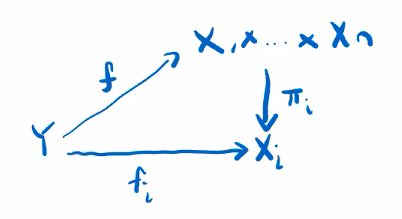
The product topology on $X_1 \times … \times X_n$ satisfies $(P_P)$: For any topological space $Y$, a map $f: Y \to X_1 \times … \times X_n$ is continuous if and only the components $f_i = \pi_i \circ f$ are continuous for each $i \in \curlies{1, …, n}$.
Part 2:
The product topology on $X_1 \times … \times X_n$ is the only topology that satisfies the characteristic property.
Proof.
Part 1:
($\Rightarrow$) Suppose $X_1 \times … \times X_n$ have the product topology.
Let $f: Y \to X_1 \times … \times X_n$ be continuous. Then each $f_i = \pi_i \circ f : Y \to X_i$ is continuous because it is a composition of continuous functions.
($\Leftarrow$) Suppose each $f_i$ is continuous.
We can prove that $f$ is continuous by proving that the preimage of each basis element of $X_1 \times … \times X_n$ is open.
Suppose $B \in \B_{X_1 \times … \times X_n}$, then $B = U_1 \times … \times U_n$ where each $U_i$ is open.
\[\begin{align} f^{-1}(B) &= \curlies{y \in Y : f(y) \in U_1 \times ... \times U_n} \\ &= \curlies{y \in Y : f_1(y) \in U_1, ..., f_n(y) \in U_n} \\ &= \bigcap_{i=1}^n f_i^{-1}(U_i) \end{align}\]This is an intersection of open sets as each $f_i$ is continuous, so it is open. Thus, $f^{-1}(B)$ is open for each $B \in \B_{X_1 \times … \times X_n}$, so $f$ is continuous.
Part 2:
Suppose a topology $\T’$ on $X_1 \times … \times X_n$ satisfies $(P_P)$.
Claim: $\pi_i : (X_1 \times … \times X_n, \T’) \to (X_i, \T_i)$ is continuous:
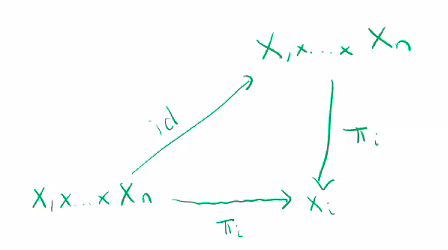
Consider $id_{X_1 \times … \times X_n} : (X_1 \times … \times X_n, \T’) \to (X_1 \times … \times X_n, \T’)$
This is continuous, so by $(P_P)$, each $\pi_i$ is continuous.
Now, we will prove that $\T’$ is the product topology.
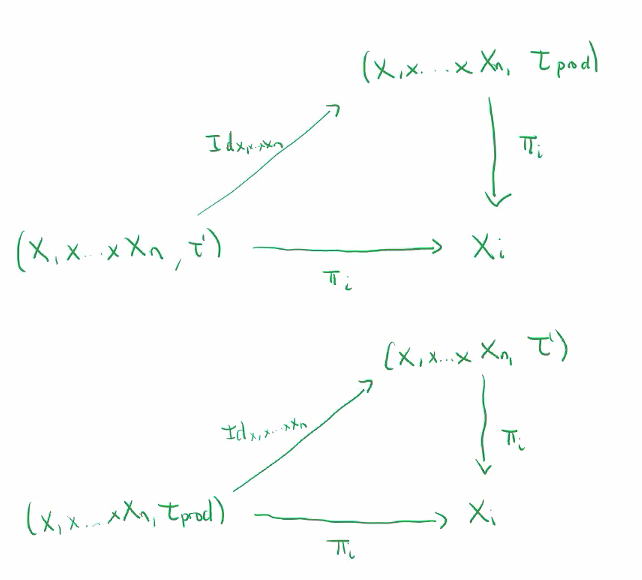
Because the projection $\pi_i : (X_1 \times … \times X_n, \T’) \to (X_i, \T_i)$ is continuous, the identity $id: (X_1 \times … \times X_n, \T’) \to (X_1 \times … \times X_n, \T_{prod})$ is continuous.
The projection $\pi_i : (X_1 \times … \times X_n, \T_{prod}) \to (X_i, \T_i)$ is always continuous, so the inverse identity $id^{-1}$ is also continuous.
Identity functions are only homeomorphisms when both spaces have the same topology, so $\T’ = \T_{prod}$.
“In the beginning, they look like black magic!” - Malors, on diagrams
The product topology is nice
Associativity of products
If $X_1, X_2, X_3$ are topological spaces, then taking product spaces is associative:
\[(X_1 \times X_2) \times X_3 = X_1 \times (X_2 \times X_3)\](if each product has its product topology)
Proof.
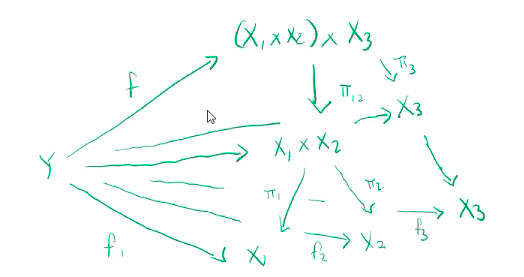
$f_{12}$ and $f_3$ are continuous if and only if $f$ is continuous if and only if $f_1$ and $f_{23}$ are continuous.
“We want to use diagrams in a way that makes things more clear.” - Malors