The Quotient Topology
\[\newcommand{\ds}{\displaystyle} \newcommand{\curlies}[1]{\left\lbrace #1 \right\rbrace} \newcommand{\T}{\mathcal T} \newcommand{\Ext}{\text{Ext}} \newcommand{\B}{\mathcal B} \newcommand{\Sp}{\mathbb S}\]The Quotient Topology
Let $q : X \to Y$ be a surjective map and $X$ be a topological space. We define the quotient topology on $Y$ by
\[\T_{quot} = \curlies{ V \subseteq Y : q^{-1}(V) \subseteq X \text{ is open}}\]Equivalently, if $q: X \to Y$ is a surjective map between topological spaces, we say $q$ is a quotient map if
\[V \subseteq Y \text{ is open} \Leftrightarrow q^{-1}(V) \subseteq X \text{ is open}\]The quotient topology is a topology
- $\emptyset$ and $Y$
- $q^{-1}(\emptyset) = \emptyset$ and $q^{-1}(Y) = X$, which are both open, so $\emptyset, Y$ are open
- Arbitrary unions
- $\ds q^{-1}\left(\bigcup_{\alpha} U_\alpha\right) = \bigcup_{\alpha} q^{-1}\left(U_\alpha\right)$ which is a union of open sets in $X$, so it is open
- Finite intersections
- $\ds q^{-1}\left(\bigcap_{i=1}^n U_i\right) = \bigcap_{i=1}^n q^{-1}\left(U_i\right)$ which is a finite intersection of open sets in $X$, so it is open
Philosophy of quotient maps
- We begin with a topological space $(X, \T)$ and we want to glue certain points together We can do this by giving an equivalence relation on $X$, which partitions $X$ into equivalence classes. The set of equivalence classes is denoted by $X/\sim$.
- This provides us with a map $\pi : X \to X/\sim$, and $X/\sim$ has no topology but we can assign it the quotient topology. So equivalence classes are “close” if the points that map to them are “close.”
- $X/\sim$ thus becomes a topological space, but it is still abstract. We want to identify $X/\sim$ with another topological space that is more concrete. We can do this by studying the gluing on $X$ directly.
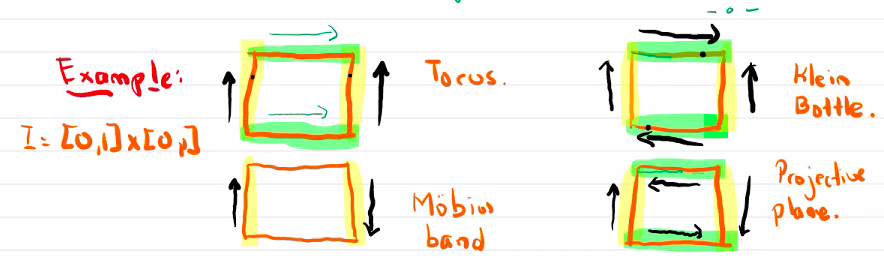
Example: The unit square and the torus
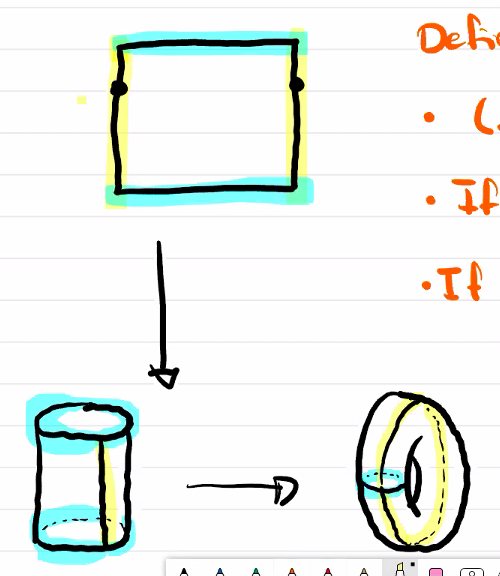
Consider $I = [0, 1] \times [0, 1] \subseteq \R^2$.
Define $\sim$ by:
- if $(x, y) = (u, v)$ then $(x, y) \sim (u, v)$
- for all $y$, $(0, y) \sim (1, y)$
- for all $x$, $(x, 0) \sim (x, 1)$
Fibers
Let $f: X \to Y$ be a map.
A fiber of $f$ is a set $f^{-1}(y)$ for $y \in Y$.
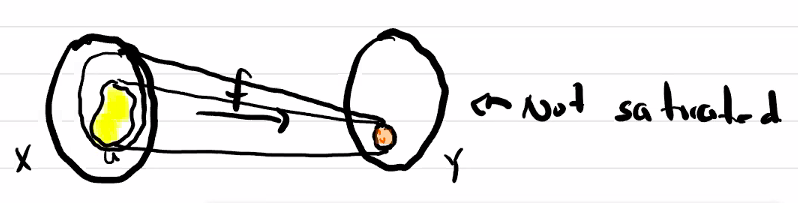
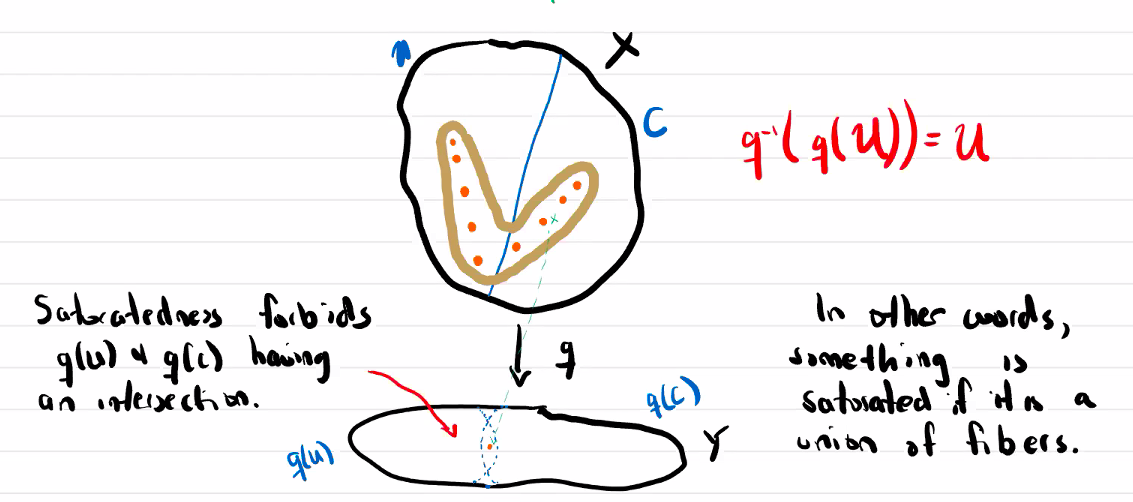
A set $U \subseteq X$ is saturated if $f^{-1}(f(U)) = U$.
Quotient maps and saturated sets
- A continuous surjective map $q : X \to Y$ is a quotient map if and only if it sends saturated open sets (or saturated closed sets) to open sets (or closed sets)
- Compositions of quotient maps are quotient maps
- An injective quotient map is a homeomorphism
- If $q : X \to Y$ is a quotient map, then $K \subseteq Y$ is closed if and only if $q^{-1}(K) \subseteq X$ is closed
- If $q : X \to Y$ is a quotient map and $U \subseteq X$ is a saturated open set, then $q\vert_U : U \to q(U)$ is a quotient map.
Proof.
Part 1.
($\Rightarrow$) Suppose $q$ is a quotient map.
Suppose $U \subseteq X$ is a saturated open set. By definition of quotient spaces, $q(U)$ is open if and only if $q^{-1}(q(U))$ is open. Since $U$ is saturated, $q^{-1}(q(U)) = U$, so $q(U)$ is open.
Suppose $C \subseteq X$ is a saturated closed set. We want to prove that $q^{-1}\left(q(C)^C\right)$ is open
…
($\Leftarrow$) Suppose $q$ sends saturated open sets to open sets.
We need to prove $q: X \to Y$ is a quotient map, so $V \subseteq Y$ is open if and only if $q^{-1}(V) \subseteq X$ is open.
Since $q$ is continuous we already have one direction. For the other, suppose $q^{-1}(V) \subseteq X$ is open. $q^{-1}(V)$ is saturated since $q^{-1}(q(q^{-1}(V))) = q^{-1}(V)$. Since it is saturated and open, $q$ maps it to an open set $q(q^{-1}(V)) = V$, so $V$ is open. Thus, $V$ is open if and only if $q^{-1}(V)$ is open.
Lemma. A closed surjective continuous map or open surjective continuous map is a quotient map.
This follows immediately from 1.
Example: Quotient maps on the unit square
Quotient maps and topological properties
“The quotient topology can destroy almost everything.” - Malors
Quotient maps do not necessarily preserve many properties!
E.g. consider the equivalence relation on $\R$:
- $x \sim y$ if $x = y$
- $x \sim y$ if $x, y \in \mathbb Z$
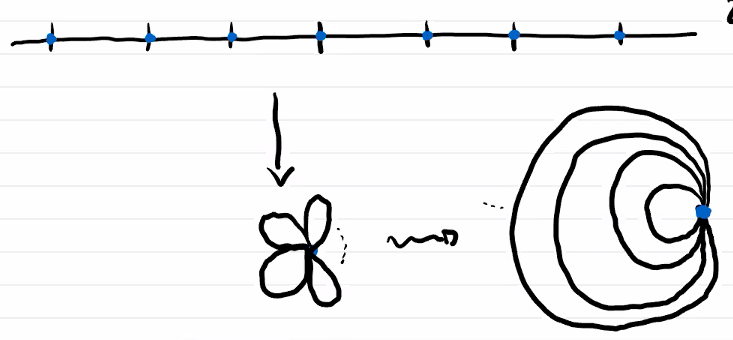
The real line is first and second countable, but the gluing is not!
Characteristic property of quotients
Let $X$ be a topological space and $q: X \to Y$ a surjective map.
Part 1:
The quotient topology on $Y$ induced by $q$ satisfies $(P_Q)$: for all topological spaces $Z$ and maps $f: Y \to Z$, $f$ is continuous if and only if $f \circ q: X \to Z$ is continuous.
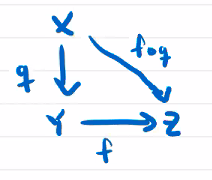
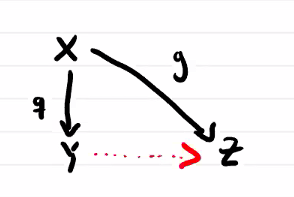
Remark: from the perspective of maps and sets, if we have $g : X \to Z$ and we want to use the characteristic property, then $g$ must respect the identifications made by $q$, i.e. if $q(x_1) = q(x_2)$ then $g(x_1) = g(x_2)$.
Part 2:
The quotient topology on $Y$ induced by $q$ is the only topology on $Y$ that satisfies $(P_Q)$.
Proof
Part 1:
Suppose $q : X \to Y$ is a quotient map.
($\Rightarrow$) If $f : Y \to Z$ is continuous then the composition $f \circ q$ is continuous
($\Leftarrow$) Suppose $f \circ q: X \to Z$ is continuous. Let $V \subseteq Z$ be open, then $(f \circ q)^{-1}(V) \subseteq X$ is open. Equivalently, $q^{-1}(f^{-1}(V))$ is open. However, $q^{-1}(U)$ is open if and only if $U$ is open, so $f^{-1}(V) \subseteq$ must be open. Thus $f$ is continuous.
Part 2:
Suppose $(Y, \T)$ satisfies $(P_Q)$. Then setting $Z = Y$,
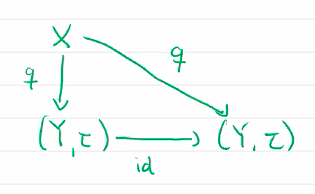
Since the identity is continuous, by $(P_Q)$, $q$ is continuous.
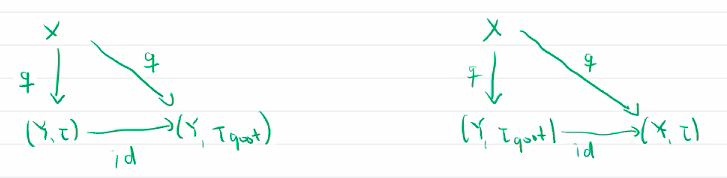
The diagonal map $q$ is continuous in both of these diagrams, so by $(P_Q)$ the identity is a homeomorphism, so $\T = \T_{quot}$.
Corollary: Uniqueness of quotient spaces
Let $X$ be a topological space and $q_1: X \to Y_1$ and $q_2 : X \to Y_2$ be quotient maps. If $q_1(x) = q_1(y) \Leftrightarrow q_2(x) = q_2(y)$, then $Y_1 \cong Y_2$.
Example: The projective plane
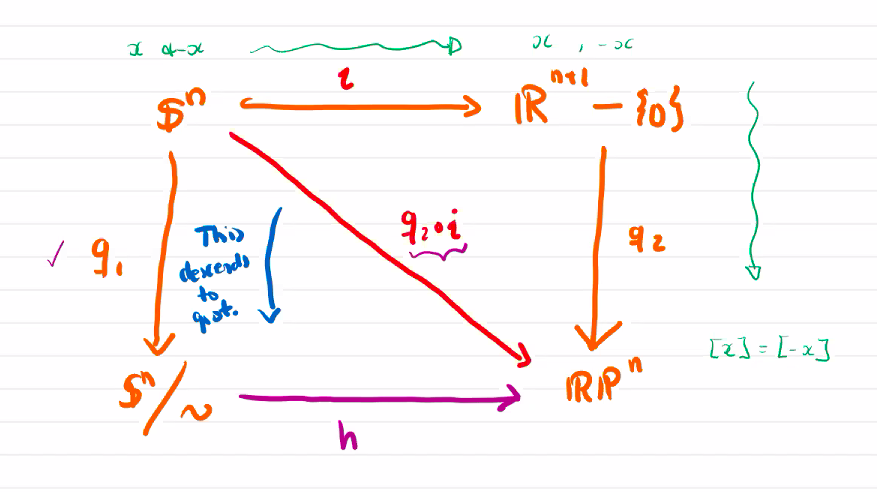
Let $X = R^{n+1}$, and define an equivalence relation $\overset{1}{\sim}$ on $R^{n+1} \setminus \curlies{0}$ by $x \overset{1}{\sim} y$ if $x = \lambda y$ for some $\lambda \in \R, \lambda \neq 0$. We define the projective plane as $\mathbb{RP}^n = (R^{n+1} \setminus \curlies{0}) / \overset{1}{\sim}$.
Now take $\Sp^n \subseteq R^{n+1}$ and define $\overset{2}{\sim}$ on $\Sp^n$ by $x \overset{2}{\sim} x$ and $x \overset{2}{\sim} -x$. We endow $\Sp^n$ with the subspace topology, then we can also define the projective plane $\mathbb{RP}^n = \Sp^n / \overset{2}{\sim}$.
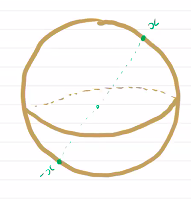
We can make these equivalent constructions because $(R^{n+1} \setminus \curlies{0}) / \overset{1}{\sim}$ and $\Sp^n / \overset{2}{\sim}$ make the same identifications, so they are homeomorphic.