Compactness
\[\newcommand{\ds}{\displaystyle} \newcommand{\curlies}[1]{\left\lbrace #1 \right\rbrace} \newcommand{\T}{\mathcal T} \newcommand{\Ext}{\text{Ext}} \newcommand{\B}{\mathcal B} \newcommand{\Sp}{\mathbb S}\]Compactness
Let $X$ be a topological space. We say $X$ is compact if for every open cover $U = \curlies{U_\alpha}_{\alpha \in A}$ there is a finite subcover. That is there are $\alpha_1, …, \alpha_n$ so that
\[X = U_{\alpha_1} \cup ... \cup U_{\alpha_n}\]If $A \subseteq X$ is compact with the subspace topology we say it is a compact subspace.
Compactness is a way to recover properties of finite or “small” spaces. Finite spaces are compact, as every open cover is finite. Furthermore, many statements about finite spaces can be restated for compact spaces.
One thing that depends on compactness is discussions about maxima, minima, and critical points with nice structure. (Morse theory looks into this.)
Another application is representation theory, where compactness simplifies a lot of theorems.
Example: $\R^n$ is not compact
Consider the cover
\[U = \curlies{B_n(\mathbf 0)}_{n \in \N}\]Clearly $U$ is an open cover of $R^n$, but if we pick a finite subcover $B_{n_1}(\mathbf 0), …, B_{n_k}(\mathbf 0)$, then its union is $B_{\max(n_1, …, n_k)}(\mathbf 0)$ which is not equal to $\R^n$.
Generally, it is easier to show that things are not compact than to show that they are compact!
Remark on proving compactness
To prove that $X$ is compact, it is not enough to find a finite cover of $X$. This is not equivalent to the definition!
However, it is also difficult to start with an arbitrary infinite cover and try to find a finite subcover.
What we want to do is to find equivalent properties.
The Heine-Borel theorem
A subset of $\R^n$ is compact if and only if it is closed and bounded.
Example: $\Sp^n$ is compact
If $f: \R^{n+1} \to \R$ is defined by $f(\mathbf x) = \lvert\mathbf x\rvert - 1$, then $f$ is continuous. The preimage of a closed set under a continuous function is closed, so $f^{-1}(\curlies{\mathbf 0}) = \Sp^n$ is closed. Furthermore, $\Sp^n$ is clearly bounded as every point in it has a norm of 1. Thus by the Heine-Borel theorem, $\Sp^n$ is compact.
Note that this theorem only applies to $\R^n$! It does not make sense in a topological space that is not a metric space. Furthermore, it does not hold in metric spaces in general.
Compact spaces and limit points
Let $X$ be a compact space and $A \subseteq X$ be an infinite subset. Then $A$ has a limit point in $X$.
Proof.
Suppose $A$ is an infinite subset without a limit point. Thus, every $x \in X$ has a neighbourhood $U_x$ which does not include any point from $A$ except possibly $x$ itself. Hence,
\[\curlies{U_x}_{x \in X}\]is an open cover of $X$. By compactness, there is a finite subcover, so there are $x_1, …, x_n$ so that $X = U_{x_1} \cup … \cup U_{x_n}$. Since each $U_x$ contains at most one point of $A$, $A \setminus (U_{x_1} \cup … \cup U_{x_n}) = A \setminus \curlies{x_1, …, x_n}$. $A$ is infinite so removing a finite number of points should not make it empty, so there exists $y \in A \setminus (U_{x_1} \cup … \cup U_{x_n})$. However, $A \setminus (U_{x_1} \cup … \cup U_{x_n})$ should be equal to $A \setminus X = \emptyset$. Thus we have reached a contradiction, so there must be a limit point of $A$.
Example: $\ell^2(\R)$ is not compact
\[\ell^2(\R) = \curlies{(c_1, c_2, ...) : \sum_{i=1}^\infty c_i^2 < \infty}\]This is a metric space with distance function:
\[d((x_1, x_2, ...), (y_1, y_2, ...)) = \sqrt{\sum_{i=1}^\infty (x_i - y_i)^2}\]Inside $\ell^2(\R)$ there is a “sphere”, aka the set of points $\vec{x}$ where $d(\vec{x}, 0) = 1$.
This is closed and bounded. Now notice that the sequences
\[\begin{align} &(1, 0, 0, ...) \\ &(0, 1, 0, ...) \\ &(0, 0, 1, ...) \\ \end{align}\]all have distance $\sqrt 2$ between them, so this “sphere” has no limit points.
Thus, this sphere cannot be compact!
Limit point compactness
Let $X$ be a topolocial space. We say $X$ is limit point compact if every infinite subset of $X$ has a limit point.
The theorem above shows us that compactness implies limit point compactness.
Limit point compactness and convergent sequences
Let $X$ be a Hausdorff, first countable, limit point compact set, then every sequence in $X$ has a convergent subsequence.
Proof.
Let $\vec{x} = (x_1, x_2, …)$ be any sequence in $X$.
If any $p \in X$ shows up an infinite number of times in $\vec{x}$, then $p, p, …$ is a subsequence which converges to $p$.
Otherwise, without loss of generality, suppose that no $p \in X$ shows up in $\vec{x}$ more than once. Let $A = \curlies{x_1, x_2, …}$, then since $A$ is infinite it has a limit point, $x$.
$X$ is first countable, so we can build a sequence in $A$ $\vec{y} = y_1, y_2, …$ which converges to $x$.
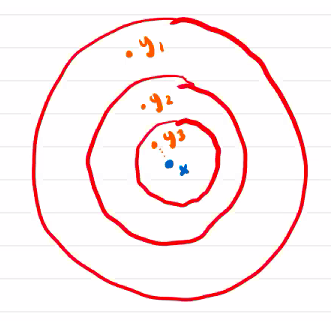
This is not a subsequence, as $y_1, y_2, …$ might not be in the same order as in $\vec{x}$.
We can construct a subsequence $\vec{z}$ by picking $y_1$, then picking the next term in $\vec{y}$ that shows up after $y_1$ in $\vec{x}$, and continuing in this fashion.
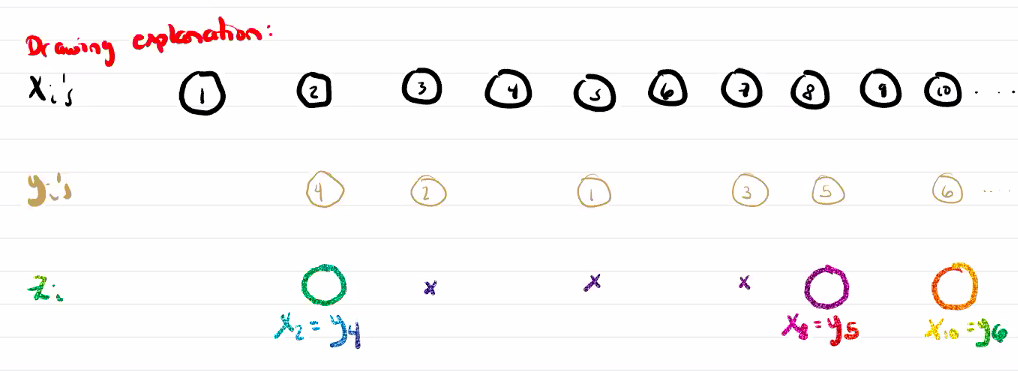
Thus, $\vec{z}$ is a subsequence of $\vec{y}$ so it converges to $x$, and it is also a subsequence of $\vec{x}$.
Sequential compactness
Let $X$ be a topological space. If every sequence in $X$ has a convergent subsequence, we say $X$ is sequentially compact.
We proved above that if a space is limit point compact, first countable, and Hausdorff then it is sequentially compact.
Sequential compactness and second countability implies compactness
Let $X$ be a second countable sequentially compact topological space. Then $X$ is compact.
Proof.
We will prove this by contradiction.
Suppose $U = \curlies{U_\alpha}_{\alpha \in A}$ is an infinite cover which does not have any finite subcovers.
Since $X$ is second countable, we can find a countable subcover $U_1, U_2, …$ of $U$. This subcover does not have any finite subcovers as well.
For every $n \in \N$, we have
\[\curlies{U_i}_{i=1}^n\]is not a subcover, so $U_1 \cup … \cup U_n \neq X$, so there exists $p_n \in X \setminus (U_1 \cup … \cup U_n)$. Then we have found a sequence $\curlies{p_n}$, and since $X$ is sequentially compact it has a convergent subsequence $p_{n_1}, p_{n_2}, …$ which converges to $p$.
Since $U_1, U_2, …$ is a cover, $p \in U_m$ for some $m$.
By definition of a limit, there exists $N \in \N$ so that if $k > N$ then $p_{n_k} \in U_m$. However, if we choose big enough $k > N$ so that $n_k > m$, then by definition $p_{n_k} \in X \setminus (U_1 \cup … \cup U_{n_k}) \subseteq (U_1 \cup … \cup U_{m})$. However, $p_n \in U_m$ as well. Thus we have reached a contradiction.
Doing things with closed sets
We can equivalently do things with closed sets if we consider intersections rather than unions.
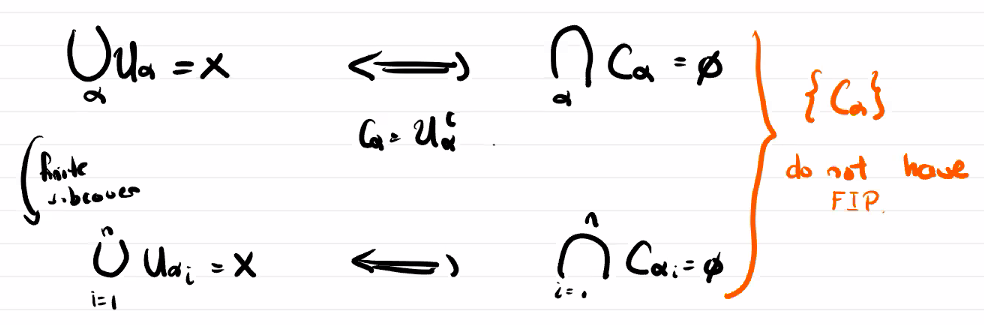
Finite intersection property.
Let $X$ be a set and $A = \curlies{A_\alpha}_{\alpha \in I}$ a collection of subsets of $X$. We say $A$ has the finite intersection property if every finite subcollection of $A$ has nonempty intersection.
Compactness and the finite intersection property
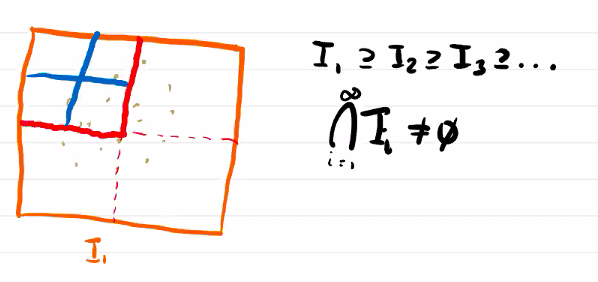
$X$ is compact if and only if every collection of closed sets with the finite intersection property has a nonempty intersection.
Example: Bolzano-Weierstrass theorem
A bounded infinite set in $\R^n$ has a limit point.
Generalizations of compactness
Compactness is a very strong property, so we want to relax our notion of it.
There are several generalizations of compactness, including
- local compactness
- paracompactness
Local compactness
Let $X$ be a topological space, then $X$ is locally compact if for every point $p \in X$, there is a compact set $K \subseteq X$ and an open neighbourhood $U$ of $p$ with $U \subseteq K$.
Precompactness
A set $A \subseteq X$ is precompact if $\overline A$ is compact. If $A$ is open then we call it a precompact open set.
This notion is important in functional analysis, where it is used to define compact operators.
Local compactness and Hausdorff spaces
Let $X$ be a Hausdorff space, then the following are equivalent:
- $X$ is locally compact
- Each point of $X$ has a precompact neighbourhood
- $X$ has a basis of precompact open sets
Proof.
It is clear that $(3) \Rightarrow (2)$.
Suppose $(2)$. Let $x \in X$ be any point. Then there exists a precompact neighbourhood $U$ of $x$, so $\overline U$ is compact. Each $x$ has a compact set $\overline U$ and a neighbourhood $U \subseteq \overline U$, so $X$ is locally compact. Thus $(2) \Rightarrow (1)$.
Suppose $(1)$. Let $x \in X$ be any point. By $(1)$, there is a compact set $K$ and a neighbourhood $U$ so that $x \in U \subseteq K$. Since $X$ is Hausdorff and $K$ is compact, $K$ is closed. We can define
\[V_x = \curlies{V \subseteq K : x \in V \text{ and } V \text{ is open}}\]Then it is clear that $U \in V_x$.
If $S \in V_x$ then $\overline S \subseteq K$. $\overline S$ is a closed subset of a compact space, so it is compact. Thus, $V_x$ is a set of precompact open sets.
Given any open set $R \subseteq X$ with $x \in R$, we know $U \cap R \subseteq K$ is open. Hence $U \cap R \in V_x$.
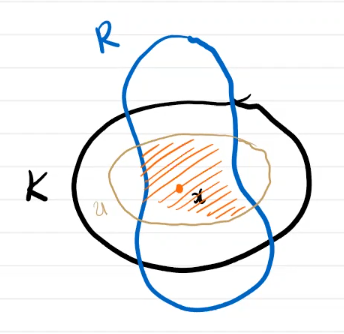
Thus $V_x$ is almost a basis, but it is contained within $K$. To find a basis for $X$, we define \(V = \bigcup_{x \in X} V_x\)
Then $V$ satisfies the properties of a basis as each $V_x$ does, and it contains only precompact open sets. Thus, $(1) \Rightarrow (3)$.
Motivation for Covers
In topology, we care about both local and global properties. These are not the same!
Global properties depend on the whole space, while local properties occur in neighbourhoods around each point.
There are several properties that occur for a space according to two things:
- They occur locally
- There is an agreement of how the property changes as we change neighbourhood
Covers “connect” local and global properties.
Example: Locally Euclidean
In a topological space $X$, an open set $U \subseteq X$ is Euclidean if it is homeomorphic to an open set of $\R^n$ (for some n).
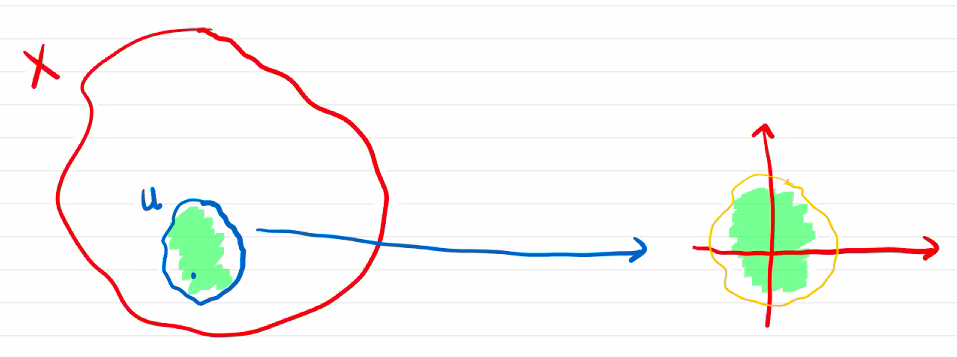
$X$ may not be homeomorphic to $\R^n$, but it may be possible that every neighbourhood is. This is useful when we define manifolds, because of the way euclidean sets can be “glued” together.
Non-example: Locally orientable

Orientability is a global property that does not translate to a local property. It is possible for every open set to be orientable while the space itself is not. So it is not useful to talk about “local orientability”.
Paracompact spaces
Refinements of covers
Let $X$ be a topological space, and let
\[U = \curlies{U_\alpha}_{\alpha \in A}\]be a cover of $X$. Then a cover
\[V = \curlies{V_\beta}_{\beta \in B}\]is a refinement of $U$ if for every $V_\beta$, there is a $U_\alpha$ with $V_\beta \subseteq U_\alpha$.
Local finiteness
A cover
\[U = \curlies{U_\alpha}_{\alpha \in A}\]is locally finite if for every point $x \in X$ there is a neighbourhood $S$ with $x \in S$ so that $S \cap U_\alpha \neq \emptyset$ for a finite number of $\alpha \in A$.
There is an agreement of how the property changes as we change neighbourhood.
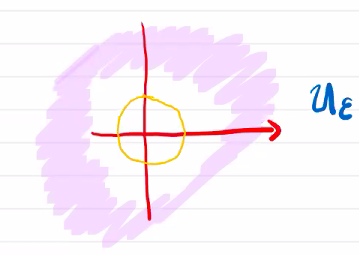
For example, consider the cover of $\R^2$ consisting of complements of closed disks as well as the unit disk: \(U = \curlies{\overline{B_\epsilon(\mathbf 0)}^C : \epsilon > 0} \cup \{B_1(\mathbf 0)\}\) This is not locally finite at $\mathbf 0$.
Paracompactness
Let $X$ be a topological space. $X$ is paracompact if every open cover admits a locally finite refinement.
Paracompactness is a mild generalization of compactness.
Compactness implies paracompactness
Suppose $X$ is compact. Then an open cover has a finite subcover. Subcovers are refinements, and finite implies locally finite. Thus, every open cover has a locally fine refinement, which is the finite subcover, so $X$ is paracompact.
Every second countable locally compact Hausdorff space is paracompact
Note that this implies that $\R^n$ is paracompact! $\R^n$ is not compact though.
Partitions of unity
We care about paracompactness because it allows us to create partitions of unity, allowing us to “glue” things.
Let $X$ be a topological space and let
\[U = \curlies{U_\alpha}_{\alpha \in A}\]be an open cover of $X$. We say a family of continuous functions
\[\{\phi_\alpha : U_\alpha \to \R\}_{\alpha \in A}\]is a partition of unity subordinated to $U$ if:
- $0 \leq \phi_\alpha(x) \leq 1$
- $\text{supp } \phi_\alpha \subseteq U_\alpha$ (the support of a function $\phi$ is the set $\curlies{x : \phi(x) \neq 0}$)
- $\curlies{\text{supp } \phi_\alpha}_{\alpha \in A}$ is locally finite
- for every $x \in X$, $\ds \sum_{\alpha \in A} \phi_\alpha(x) = 1$
Discussion
Properties 1 and 2 make each function act as a sort of “indicator” function
Property 3 makes it so that at each point, only a finite number of functions is non-zero. As a result, property 4 makes sense because the summation is well defined (without worrying about convergence) because only a finite number of values must be added.
Example: Gluing functions together
Let $X$ be a topological space that admits partitions of unity, and let
\[U = \curlies{U_\alpha}_{\alpha \in A}\]be an open cover of Euclidean neighbourhoods of dimension 2.
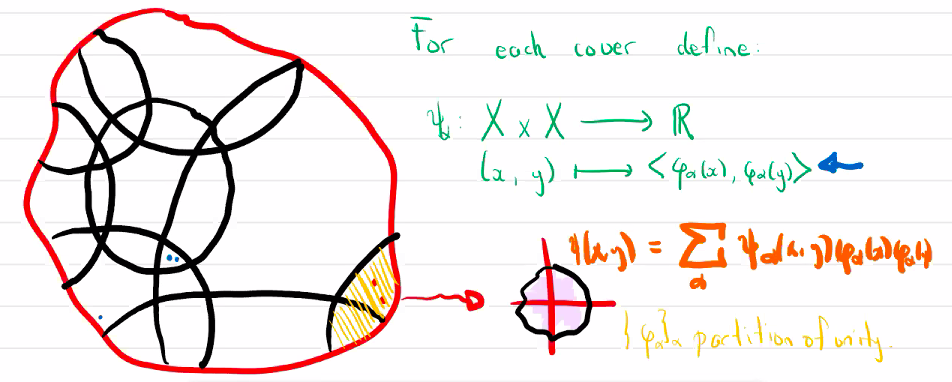
We can define a function $\psi_\alpha$ on each $U_\alpha$, and glue these functions together with our partition of unity for this cover. This results in a well-defined function $\psi$ on all of $X$.
Existence of partitions of unity
Let $X$ be a paracompact Hausdorff space. If $U$ is a cover of $X$ then there exists a partition of unity subordinated to $U$.
Paracompactness and separation
There are two generalizations of Hausdorff spaces, regular spaces and normal spaces.
Regular spaces
Let $X$ be a topological space. $X$ is regular if we can separate a point $p$ and a closed set $C$ into disjoint open sets. i.e. we can find disjoint open $U, V \subseteq X$ so that $p \in U$, $C \subseteq V$.
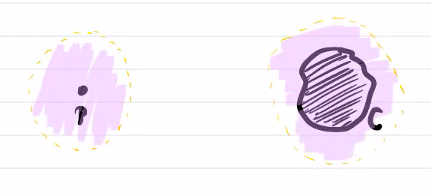
Note that sometimes, “regular” is used to mean regular and Hausdorff and “quasiregular” is used to mean regular but not necessarily Hausdorff. This is the case in Lee’s book.
Normal spaces
Let $X$ be a topological space. $X$ is normal if we can separate closed sets into disjoint open sets. i.e. if $A, B \subseteq X$ are closed and disjoint, we can find disjoint open sets $U, V \subseteq X$ so that $A \subseteq U$ and $B \subseteq V$.
A Hausdorff paracompact space is normal.
Normality is equivalent to the existence of partitions of unity!
Note that this term has the same issue as regular spaces with regards to being Hausdorff.
Urysohn’s lemma
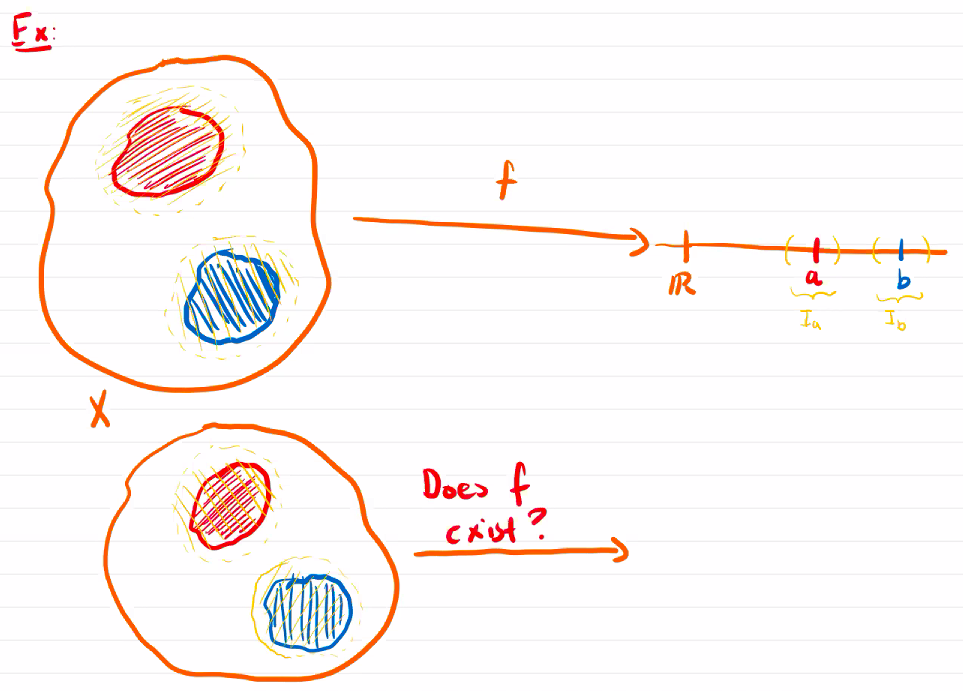
We think about normal sets when we want to think about preimages of different points.
#####
Let $X$ be a normal and Hausdorff topological space, and let $A, B \subseteq X$ be disjoint closed subsets. Then there exists a continuous function $f : X \to [0, 1]$ so that $f(A) = \curlies{0}$ and $f(B) = \curlies{1}$.